Find out if your music will be turned down by YouTube, Spotify, TIDAL, Apple Music and more. Discover your music's Loudness Penalty score, for free.

Drag and drop an audio file here

Choose an audio file

MP3 or WAV

select a file

Your file will not be uploaded, stored or shared, meaning this process is secure and anonymous.

Online streaming services are turning down loud songs.

We all hate sudden changes in loudness - they're the #1 source of user complaints.

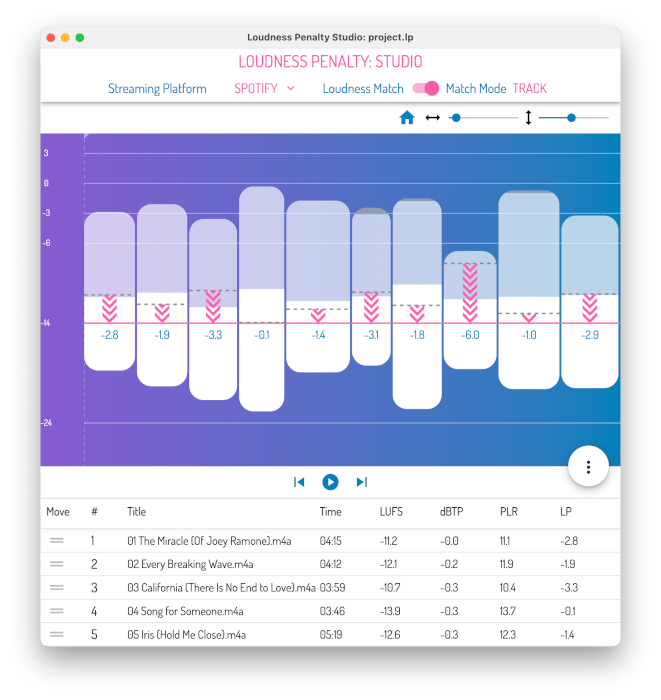
To avoid this and save us from being "blasted" unexpectedly, online streaming services measure loudness, and turn down music recorded at higher levels. We call this reduction the "Loudness Penalty" - the higher the level your music is mastered at, the bigger the penalty could be. But all the streaming services achieve this in different ways, and give different values, which makes it really hard to know how big the Loudness Penalty will be for your music...

Until now.

Simply select any WAV, MP3 or AAC file above, and within seconds we'll provide you with an accurate measurement of the Loudness Penalty for your music on many of the most popular music streaming services, and allow you to preview how it will sound for easy comparison with your favorite reference material.

Your file will not be uploaded, meaning this process is secure and anonymous.

Do you have any questions? Get in touch.
Processing audio

(but NOT uploading)

RESULTS (in dB)

0 YouTube
0 Spotify
0 TIDAL
0 Apple
0 Apple (Legacy)
0 Amazon
0 Pandora
0 Deezer

Want to take control of the Loudness Penalty for your music?

Find out how to optimize your music for impactful, punchy playback (and maximum encode quality) for all the online streaming services. Plus, receive a Loudness Penalty Report for your file that explains in detail what all the numbers mean.

Analyze another file

We just sent you an email with your report!

Analyze another file Visit MeterPlugs.com

Ећeytan Д°ncili: Kд±yamet Вђ“

This guide explores the concept of the (Devil's Bible), often associated with themes of the Apocalypse (Kıyamet) in literature, history, and pop culture. It primarily refers to the historical Codex Gigas and the thriller novel by Patrick Graham . 1. Historical Foundation: The Codex Gigas

The narrative centers on a secret Bible written in the 14th century by a nun named Yseult. This "Black Gospel" claims that Jesus was the son of Satan. Şeytan İncili Kıyamet –

A 1631 version of the King James Bible is often called the "Sinner's Bible" because of a typo in the Ten Commandments: "Thou shalt commit adultery" (omitting the "not"). This guide explores the concept of the (Devil's

The book deals with an ancient war of angels and a looming apocalypse where the fate of humanity is at stake. Historical Foundation: The Codex Gigas The narrative centers

According to legend, a monk broke his monastic vows and was sentenced to be walled up alive. To escape this fate, he promised to write a book containing all human knowledge in a single night. Realizing he couldn't finish, he allegedly prayed to Lucifer for help, who finished the book in exchange for the monk's soul.

The story follows Marie Parks , an FBI agent with supernatural abilities who specializes in catching serial killers.

The phrase "Şeytan İncili" is sometimes used to describe historical printing errors or theological debates:

Scroll down to learn more about "Loudness Penalty"
Scroll down to learn what these numbers mean